
Master dissertation studio 2026-27
Supervisors: Johannes Berry and Johan Nielsen
Campus Sint-Lucas Brussels
Introduction
“In theory and in practice, the stranger enjoys greater freedom than the ordinary man. The stranger can survey a situation without bias and makes judgments based on objective and universal ideals. His actions are not restricted by custom, allegiance, or precedent.” – Georg Simmel
As we are becoming ever more interconnected through our digital world, there is a growing realization of how disconnected we have become from our physical world. Our digital world has connected our minds, and in the process revealed the interconnectedness and consequences of our actions in the physical world.
Like Adam and Eve, our eyes have been opened, we have consumed the forbidden fruit, have lost our innocence, and become strangers in our own world. We now find ourselves in a place that is somehow familiar, but also different, one in which whar we thougth were our shared frame of reference or values have become questionable.
In this kind of world, Filarete’s Adam is confronted with hostile weather for the first time, and throws up his arms to protect his head (fig.1.). In realising the need for more permanent protection, he recalls the action and shape of his arms, which fortuitously creates a stable form when constructed with branches. For Filarete’s Adam, this becomes the first reference, and start of architecture (fig.2.), arbitrary but pragmatic.


fig. 1. Trattato di architettura, Filarette, 15th c. Vitrivius Adam reacting to the weather.
fig. 2. Trattato di architettura, Filarette, 15th c. Vitrivius Adam’s shelter inspired by the shape of his reaction to the weather
We find ourselves in a world with many things left behind from our past. Our situation is comparable to the analogy in the 1977 book, Roadside Picnic by the Strugatsky brothers, where the character Dr Valentine Pilman, compares a visitation from extra-terrestrials to a picnic. He compares the anomalies and objects left behind by extra-terrestrials visiting earth, to that of humans left behind in nature after a picnic. Just like the animals, we humans might find these objects and anomalies meaningful beyond what it really is, trash left behind.
There lies greater opportunity in looking at the potential of these things, than projecting meaning onto them. This approach is well illustrated in the experiment by the French artist Hubert Duprat. When Duprat substitutes the caddisfly larvae’s environment with precious stones, pearls and gold, the larvae, without hesitation or considering the meaning of the new materials, spin them into cocoons (fig.3.).

fig. 3. Trichoptera, Hubert Duprat, 1980 – Caddis Larvea’s Coccon spun from precious stones, pearls and gold.
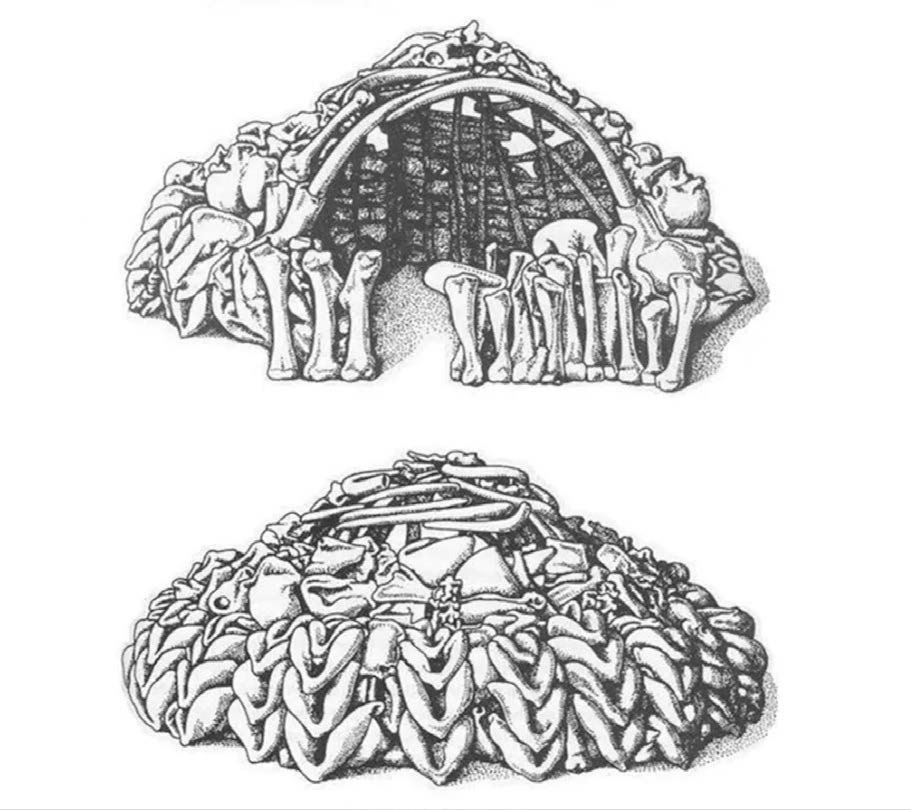
In this changing environment, we should deal with uncertainty not with ideas or dreams of how we want things to be, but rather, in trying to connect with this new world, try to find potential in what things can become. In this way, it makes sense to limit ourselves to the potential of what is available rather than the dream of what we want. A good example illustrating this approach is the mammoth bone shelters our ancestors built after the peak of the last ice age. As the climate became very unpredictable and hostile, our ancestors had to make do with what they could get (fig.4.).
We are at the beginning, like Filarete’s Adam, and the act of creating is a way for our minds to reconfigure our physical world. Like Francis Alys’s shelter, (made of election posters tied to a ventilation grill and held up by the rising air) (fig.5.) rather than trying to solve the issues of the world, there is enough potential in materials, construction, and the environment to find connection again with the physical world, and inspire alternative forms of architecture.

fig. 4. Author Unknown, Mamoth Bone Shelter, from after the peak of the last ice age.
fig. 5. Vivienda para todos, Francis Alys, 1994. A shelter made of election posters tied to a ventilation grill and held up by the rising air.
- Read the full studio description here.