
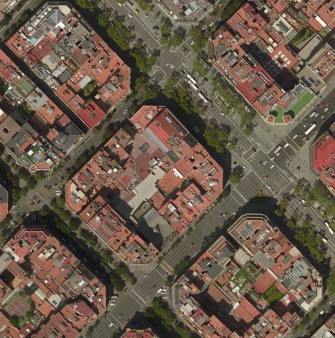
Resilient Collective Spaces: the case of Barcelona.
January 28th – February 1st 2015, Barcelona
Workshop, KU Leuven, Department of Architecture, Belgium,
Streetscape Territories Research Project and Research Group “Urban Projects, Collective Spaces and Local Identities”
Resilient Collective spaces: Rethinking urban spaces defined by commercial programs.
Today, the impact of a growing secularization, the substantial increase of leisure time and the economic transformation based on consumption in a western context redefine the main actors in the contemporary city and affect how we experience and use collective spaces as part of our daily environment.
The morphological understanding of these collective spaces (Solà-Morales, 2008) as shared areas -that are no longer exclusively defined by public/private property structures but by different ways of sharing them- and the influence of commercial programs on the design of this kind of spaces, suggest to rethink collective strategies for all kinds of shared spaces, independently of scale or size.
During the last decade, Barcelona has seen how a massive number of commercial activities conquer the city. Shops, bars, restaurants, hotels, or including informal vendors on each corner have an influence on how we experience the urban environment and how they are part of the collective space, extending or intensifying in a certain way the existing urban fabric.
Can we take advantage of the impact of commercial elements to regenerate our collective spaces in a qualitative way by changing how this type of programs are planned or designed?
There are several selected study urban projects, all of them situated in the city center and connected with the most active areas in Barcelona. These areas are characterized by strong presence of commercial programs and people, producing conflicts, contradictions or overlaps in the use of space. At one hand these are the most vivid areas, but at the same time these spaces become each time more disconnected from the real life of the city.
Approaches:
Barcelona, multi-layered with a complex context: areas with a strong urban and economic potential, under the pressure of touristic and commercial activities.
Accessibility, permeability and interaction as an urban strategies against social exclusion.
Informality and unexpected use of space as a key for quality of spaces in urban projects
Keywords:
Collective spaces, urban project, commercial programs, visibility, proximity, permeability, accessibility, streetscape and use of space.
Participation: call
– Call for participation: November 18th, 2015
– Deadline for submitting motivation letter*: Nov. 27th, 2015
– Notification of acceptance: December 4th, 2015
– Deadline confirmation travel arrangements: Dec. 7th, 2015
Selection criteria and organisation:
Eligible for participation are all 3rd year Bachelor and Master students in Programs of Architecture (including Erasmus or other exchange students).
The participation is without charge and the selection based on motivation letter*.
Availability: max. 8 students.
Accommodation during the workshop ( January 28th – February 1st ) will be paid and provided by the organisation.
All participants book and pay the needed travel accommodation and agree to be present on January 28th 2016 on the previously communicated meeting point (late arrivals or early leave will not be accepted, unless there is an overlap with theoretical exams in the first days of the workshop).
All participants are personally responsible to obtain all legal documents and permits to travel and stay in Barcelona (Spain) during the workshop.
For more information: email to ferran.massipplanas@kuleuven.be
*submission of a motivation letter (convince us why we would select you!), 1 image and max 250 words, in English, adding short cv with ID photo, all in one pdf file (max 2MB totally)
to be sent to: ferran.massipplanas@kuleuven.be
http://streetscapeterritories.wordpress.com
http://www.collectivespaces-kuleuven.be/