
Structural Typologies — Harvest
Master dissertion studio
Supervisor: Floris De Bruyn
Sint-Lucas Ghent Campus
Language: NL
Description of the project (ENG):
This studio continues our ongoing typological research into existing buildings. Earlier investigations into garages, palazzi, gas stations, vernacular rural structures, and urban building blocks have produced a vast archive of drawings: an Atlas of the Existing.[1] This atlas documents the primary structures of buildings through detailed analytical drawings.
Faced with the urgency of adaptive reuse, the direction of the design process must now be reversed. Rather than beginning with program or form, design starts with what already exists: the available material. At any given moment, a project should be capable of radical transformation in response to the materials salvaged from a demolition site.
The studio brief: design a new project that is 100% reuse — in both structure and dressing, from foundation to ornament. The Atlas is our quarry. After years of urban mining, it is now time to harvest.
The Atlas is both real and imaginary. Real, because it records actual buildings that will inevitably require repair, restoration, alteration, or demolition. Imaginary, because once archived, these buildings are liberated from their original context and open to new forms of use. Whether a work by Mies van der Rohe, a building by Álvaro Siza, a modernist icon, a historic palazzo, a garage, or an anonymous shed, each can be dismantled and reconstructed within the logic of the archive.
The elements and artefacts contained within the Atlas are not only repositories of stored carbon; they also embody cultural value, habits of occupation, construction knowledge, and typological intelligence. These can be revisited, recombined, and used in new conditions.
Harvest is not merely the extraction and reuse of material; it is a ritual act: a collective recognition that buildings are never inert objects, but accumulations of labour, memory, technique, and cultural meaning. To harvest is to dismantle carefully, to gather deliberately, and to reassemble with awareness.
Nothing can be invented. The Atlas is the material.
Studio
Typological Observation
Theoretical and analytical investigations into typological strategies for adaptive reuse.
Atlas Investigation
Collective reading of the Atlas through the analysis of typologies, structural systems, material assemblies, and architectural artefacts.
Site Analysis
Photographic survey and measured documentation of the site and its existing conditions.
Primary Structure
Design of the building’s primary structural system through the reuse and recombination of elements drawn from the Atlas.
Dressing
Design of the building envelope as a dressing of the primary structure, developed through reused materials, assemblies, and ornament.
Output
Architectural Drawings
- Site plan, plans, section, detail
- Physical Model: A large scale model of the building. 50% structure 50% dressing
- 1 high-quality image (vertical A0) (render, collage, or drawing) that conveys the spatial ambition and atmosphere of the project.
Assessment Criteria
- Depth and originality of typological analysis
- Clarity and rigor in architectural representation
- Creativity and feasibility of the design transformation
- Spatial, structural, and conceptual coherence of the final proposal
- Quality and craft of the final model and image
References/Further reading:
Reuse
Stricker, Eva, en Guido Brand, red. Re-Use in Construction: A Compendium of Circular Architecture. Zurich: Park Books, 2022.
Plevoets, Bie, en Koenraad van Cleempoel. Adaptive Reuse of the Built Heritage: Concepts and Cases of an Emerging Discipline. London New York: Routledge, 2019.
Models
Thomas Schütte: Playing with materials, 2019. https://youtube.com/watch?v=z_kvdX937Mg.
Typology
Rossi, Aldo. The Architecture of the City. Cambridge: MIT Press, 1984.
Moneo, Rafael. ‘On Typology’’. Oppositions 13 (1978): 23-45.
Martí Arís, Carlos. Variations of Identity: Type in Architecture. Frankreich: Éditions Cosa Mentale, 2021.
Christ & Gantenbein. Typology Hong Kong, Rome, New York, Buenos Aires. Zürich: Park Books, 2020.
Engel, Heino, en Ralph Rapson. Structure Systems. 3. Aufl. Ostfildern: Hatje Cantz, 2007.
www.primarystructure.net
[1] https://primarystructure.net/structural-typologies/
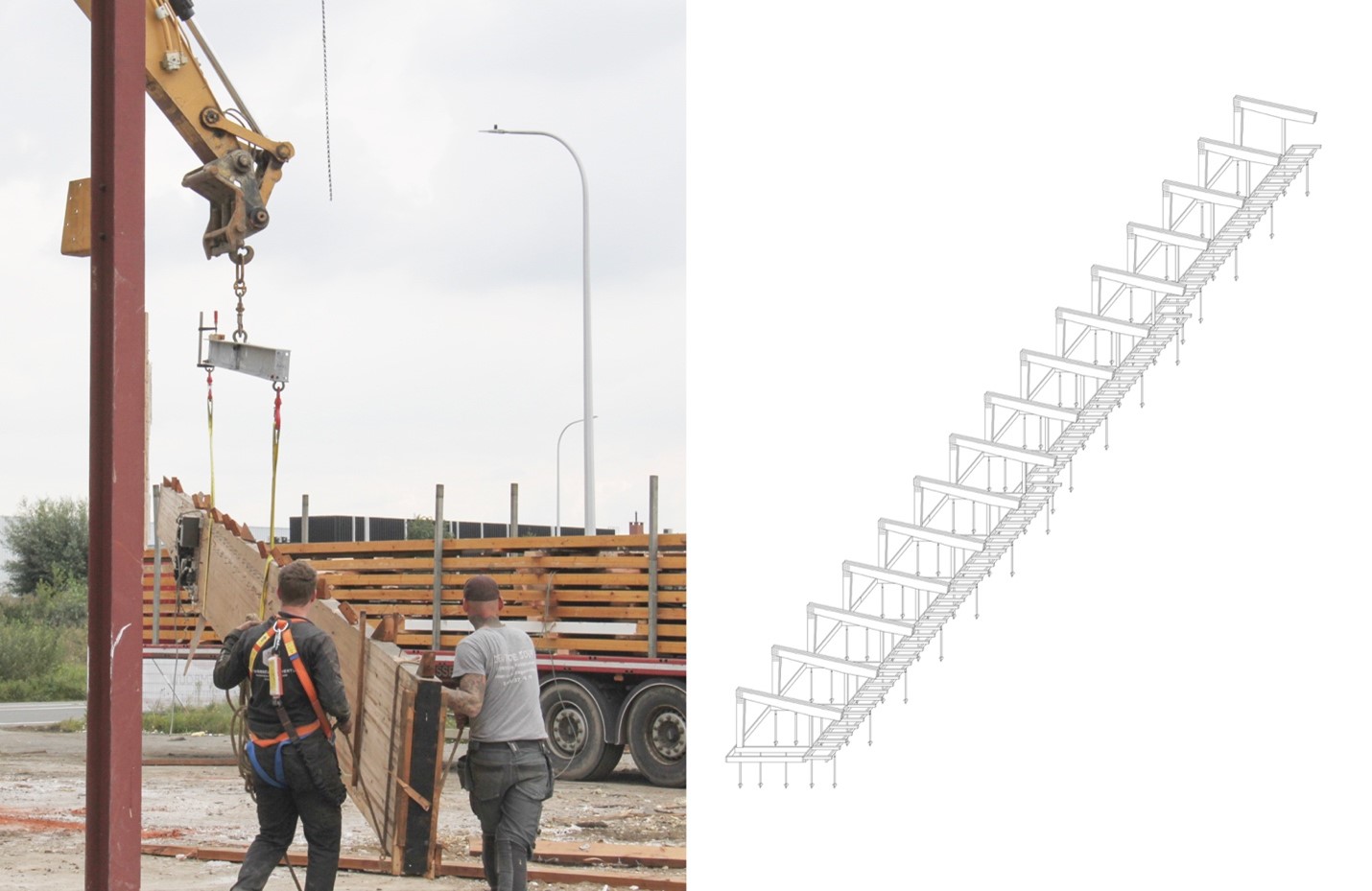
Image: G2401. Natuureducatiecentrum Zelzate. GAFPA icw. Lab15. Dismantling of an existing factory and drawing of the primary structure constructed from salvaged beams.