
New Urban Figures -case Tervuren
Tutor(s): Roeland Smits
Campus Ghent
Language: EN / NL
Engagement: Reflecting Urban Cultures
Semester 3
introduction
For some years, this studio works on densification processes within peri-urban conditions. In previous years, it mainly focused on the regional (Flemish) policy-objectives which projects >320.000 new households in Flanders until 2030-2035. Despite a classic dichotomy between the rural and the urban, part of this policy objective was seen in more peri-urban regions, mainly at the insistence of bigger cities like Antwerp.
Although, densifying within these peripheral municipalities seems at first sight a very simple assignment, it soon becomes clear that architects and urban designers often fall back on classic inner-city urban morphologies and architectural typologies. But simply copying dense urban models or typologies (as e.g. the figure of a building-block or high-rise (apartment) buildings, … ) has been proven inadequate to the complicated context of these peri-urban area’s with their seemingly unordered heterogeneous landscapes and the juxtaposition of all kinds of uses. Densification therefore, needs to be rethought with new urban models and building typologies. In contrast to the cities morphology, these peripheral conditions prove to be the perfect background for searching and testing New Urban Figures.
Today these horizontal metropolis, to quote B. Secchi, is subject for many challenges. Besides the ever increasing housing production, which translates into terms such as an increasing apartmentization of village centers, also urban facilities, commercial centers and working areas are changing in rapid succession. Although these items seem at first sight a question for spatial planners, it is believed in this studio that answers could not only arise top-down, but must also been research bottom-up, from architecture to city…. We just have to dare to imagine new urban figures.
The studio assignment
After years of working on the peri-urban area of Antwerp and the surrounding of Kortrijk, for the first time we will work with the studio of 2025-2026 within the surrounding of Brussels. The idea is provoked by a Strategic project Horizon +, made by the province of Brabant. Although this strategic project was set up in response to the spatial, ecological and social challenges in the region around the Zoniënwoud, it soon became clear that this project could not cope with the increasing urban pressure experienced by the participating municipalities. What lacks is a clear view on how urban densification could be managed.
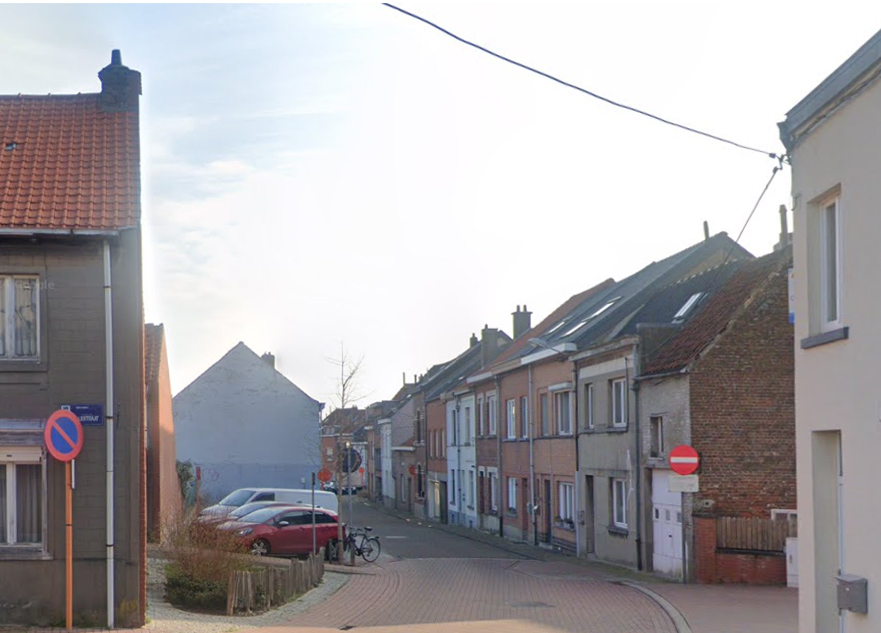
In the 2025-2026 studio, we will work on the village of Tervuren. Interesting is the historical building-block structure of Tervuren. These building-block structure can almost be seen as heritage. But although the iconic urban tissue, it is build up with small streets, a stiff architectural typology consisting of (former) workers’ houses with limited height and narrow plot structures.
The municipality is experiencing a gradual metamorphosis of these building block structure because of the increasing densification and apartementization. It is in this assignment the municipalities urban administration that is questioning the developing of new densification models on the base of research by design. This research by design strategy is used within the studio to explore new typologies or new strategies to cope the densification process
In these studio you can work on a small plot or a whole building block, the urban issue is therefore not led by a specific urban scale but more about an urban attitude. The studio focusses on the densification of the city center, but this is widely interpreted; also allotments or adjacent plots in the sub villages could be questioned. The challenges surrounding densification are primarily seen as architectural challenges and not as urban planning issues. It is thereby believed that whereas a building block originates from a sequence or juxtaposition of 1 or more architectural typologies, densification of these building blocks can be successful, by redefining these architectural typologies.
Expected output:
It is expected that the student can read patterns in a non classic urban (an seemingly ‘dull’) environment, formulate an adequate research by design question which is translated in a design proposition.
The studio focusses on reading and understanding different urban forms, their applicability within existing urban tissues and their effects towards f.e. social coherence, urban climate resilience…. The research by design can be complemented with individual interests or contemporary themes, as a first step towards the masterstudio.
Excursion/study trip/…? (+ timing):
– first studio day;
morning; Introduction in Tervuren (town hall)
Afternoon; site visit
– further excursions to be defined
References/Further reading:
– T. Burklin M. Peterek, BASICS-Urban building Blocks, Bazel, Birkhausen, 2008
– P. Panerai, J. Castex & J-C Depaule, Urban forms : death and life of the urban block, Oxford Architectural Press, 2004
– New Topographics. Photographs of a man-altered landscape. Robert Adams, Lewis Baltz, Bernd and Hilla Becher, Joe Deal, Frank Gohlke, Nicholas Nixon, John Schott, Stephen Shore, Henry Wessel, jr. Paperback – January 1, 1974
– B. De Meulder, J. Schreurs, A. Cock, B. Notteboom, Patching up the Belgian Urban Landscape, 1999, Oase
– K. Alles stad. Over een paradigma voor nieuwe stedelijkheid (UGent) (1999) Ons Erfdeel. 42(4). p.544-553
– J. Corner, The Agency of Mapping: Speculation, Critique and Invention in Dennis Cosgrove, Mappings, 1999, Reaction Books, London