
Learning from Japan: spaces for encounter 2026-27
Teacher: Hera Van Sande
Engagement: Craftsmanship
Language: EN
Campus: Ghent
Semester 1
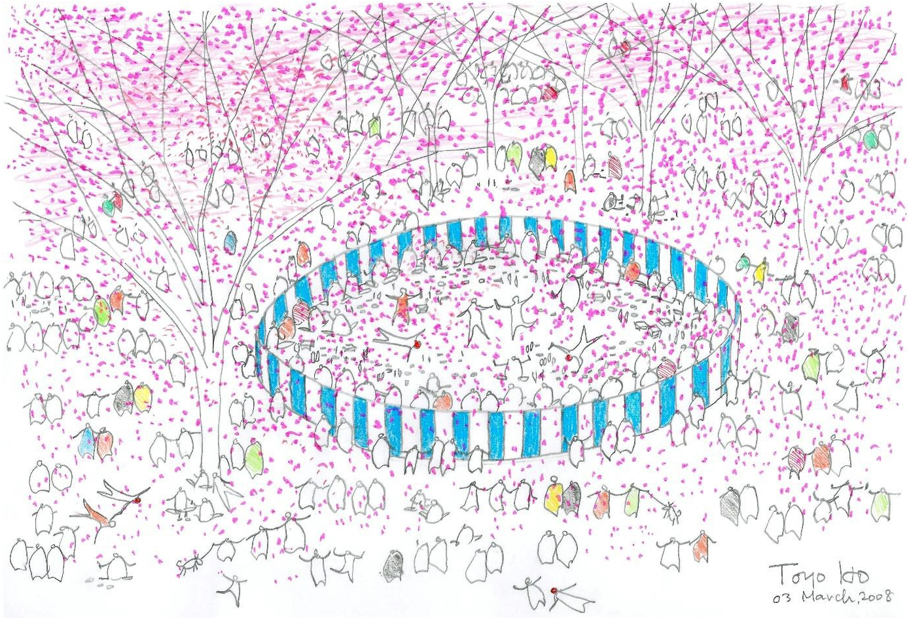
Head image: Toyo Ito, Under the Cherry Tree, 2008
How can we enhance urban community life through dynamic frameworks for human
encounter by learning from Japan?
How can we rethink space by setting aside our preconceived notions? By learning from
Japan, we study a dynamic, temporal and relational understanding of space, through the
rich and conceptual Japanese spatial vocabulary. Key is the introduction of the concept
of ma (space-time, gap, in between) by Arata Isozaki to the Western world in 1978
How can we enhance urban community life through dynamic frameworks for human encounter by learning from Japan?
How can we rethink space by setting aside our preconceived notions? By learning from Japan, we study a dynamic, temporal and relational understanding of space, through the rich and conceptual Japanese spatial vocabulary. Key is the introduction of the concept of ma (space-time, gap, in between) by Arata Isozaki to the Western world in 1978. We depart from detecting potentialities in this intercultural dialogue and dive into a world of spatial imagination.
We investigate how spatial knowledge can be generated through the interpretation of intercultural spatial concepts. Firstly, to immerse in Japanese culture, the spatial systematics and poetics of the emblematic Katsura Villa are being studied, framed by the philosophical background of Arata Isozaki’s introduction of ma. The aim is to understand Japanese space that unfolds through movement, perception and bodily engagement, focusing on threshold and in-between spaces. Parallel, spatial concepts provided by ten young Japanese architects, triggering a world of spatial thinking, are studied through drawings, sketches, modelling and writing. Students translate these concepts into spatial investigations, liberating and broadening their own spatial understanding as embodied spatial knowledge.
In the next phase we position ourselves in the city, where spaces of encounter serve as vital antidotes to urban isolation and solitude. We develop a shelter, a construction, a building, … within an existing framework. The project aims to rethink human behaviorology within the urban landscape and to investigate how small interventions restore communities.
The ambition is to develop one’s own architectural language in spatial imagination, starting from an intercultural dialogue, and implementing it in rethinking relationship between people, and between people and the city.
Fields of interest
Community
Embodied (spatial) experience
Landscape
Public Space
Transformation
Which fictional titles of possible Line(s) of Inquiry resonate with the studio?
Reframing Architecture
Working With
Global Encounters
Key Questions
Can an intercultural dialogue, by taking distance from our preconditioned way of
thinking, shift the boundaries to re-imagining, re-thinking, and re-calibrating our spatial notions?
Could the use of architectural thresholds and soft boundaries – similar to those found in Japanese space – redefine the relationship between private domestic life and the public sphere?
How can the spatial constraints of medieval street fabric and canal networks be leveraged to create small-scale, accidental “micro-public spaces” that spark spontaneous encounters?
Can we learn from how Japanese architecture leverages ancient spatial concepts re-coded for modern society to restore communities by small interventions?