
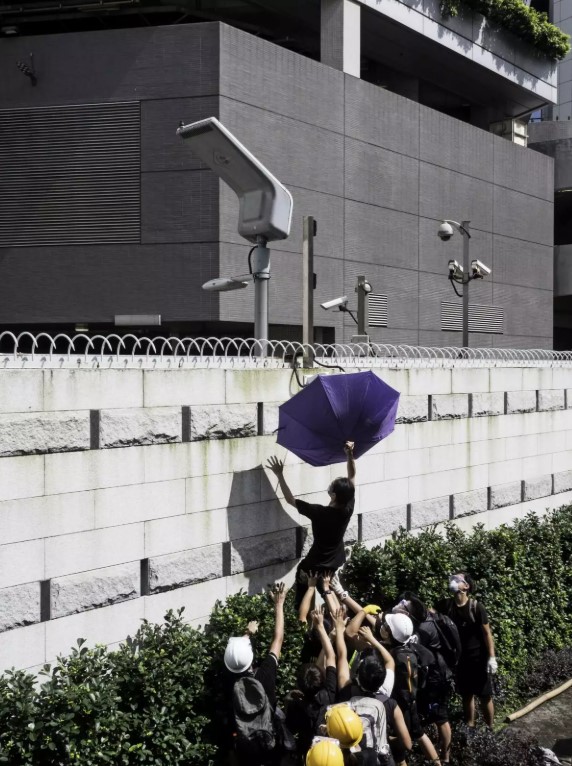
Leaking the border: Critical spatial practices from the borderlands
Masterproef 2026-27
Supervisor: Irene Feria Prados
Campus: Ghent
Language: EN
Picture left: ‘when I feel down, I take the train to Happy Valley’, Pier Francesco Celada, fotografante 2024
“A borderland is a vague and undetermined place created by the emotional residue of an unnatural boundary. It is in a constant state of transition. The prohibited and forbidden are its inhabitants, los atravesados (…), in short, those who crossover, pass over, or go through the confines of the “normal”.”
-Gloria Anzaldúa in Borderlands/La Frontera
In critical theory, bordering refers to the ongoing material and social processes through which separation is constructed and enforced. Bordering does not happen only at border walls but also within delimited territories: it materialises in refugee centres, luxury developments in marginalised neighbourhoods, hostile architecture, surveillance technologies in protest zones, gendered public infrastructure, and beyond. Spatially, bordering reveals how systems of segregation extend beyond geopolitical scales, structuring identities and spatialising exclusion within everyday environments.
This studio offers space to explore architectural possibilities to counter these processes of spatial segregation and social control. Guided by the work of Gloria Anzaldúa, we will design from the borderlands: spaces of hybridity where resistance is enforced, and transitioning is an ongoing process. At the borderlands, designing is not about solving problems, but about inhabiting tensions with transformative potential: hijacking segregationist infrastructures, supporting shared ecologies, and materialising social entanglements across borders. In this studio, leaking the border becomes a design tactic—one that acknowledges architecture’s complicity in systems of oppression and proposes ways to resist through critical, situated and activist spatial practices.
Studio description
- Framework
We draw from queer-feminist theory, decolonial thought, and critical design discourse to develop a strong conceptual foundation. These perspectives help interrogate how spatial practices reproduce systems of division across race, gender, class, citizenship, (dis)ability, and more. Theorising is not separate from designing, instead, it allows you to understand existing, complex relations and sharpens your capacity to intervene. You’ll be encouraged to develop tools for resistance, care, and relationality, rather than for resolution. - Scale
In this studio, we’ll work transscalarly, understanding architecture’s impact beyond the project’s site and recognising systemic entanglements of the built environment. A surveillance device, a shipping container or a displaced community can reveal broader networks of control and extraction. Your project might start with a place or object, but its design will be asked to engage the longer chains of implication that sustain it. - Methodology
Throughout the semester, we will centre critical mapping as a research and design method. Through collaborative mapping sessions and methodological guidance in studio days, you’ll learn to visualise exclusionary conditions while foregrounding lived experiences and invisibilised knowledges. - Outcome
Outcomes in this studio may vary in form and scale—from spatial devices to buildings, infrastructures or installations. The studio will offer space to explore alternative ways to design: planning socio-spatial structures, redesigning spaces collaboratively or building a spatial intervention are pathways to expand a traditional understanding of architectural design.
If you have questions about the studio, feel free to email me or reach out on campus!
Selected references:
Gloria Anzaldúa, Borderlands / La Frontera: The New Mestiza (1987)
ARCH+, Europa: Structures of Externalising, Issue 231 (2018)
Theo Deutinger, Handbook of Tyranny (2018)
Kollektiv Orangotango (eds.), This Is Not an Atlas (2018)
The Funambulist Magazine, Issue 51: The Undocumented International (2024)
Ruben Pater, The Politics of Design (2016)
Harsha Walia, Undoing Border Imperialism (2013)
Sara Ahmed, Queer Phenomenology: Orientations, Objects, Others (2006)

Picture: ‘XHOLOBENI YARDS. Titanium and the Planetary Making of SHININESS / DUSTINESS’, Andrés Jaque/ Office for Political Innovation, 18th Venice Architecture Biennale, 2023