
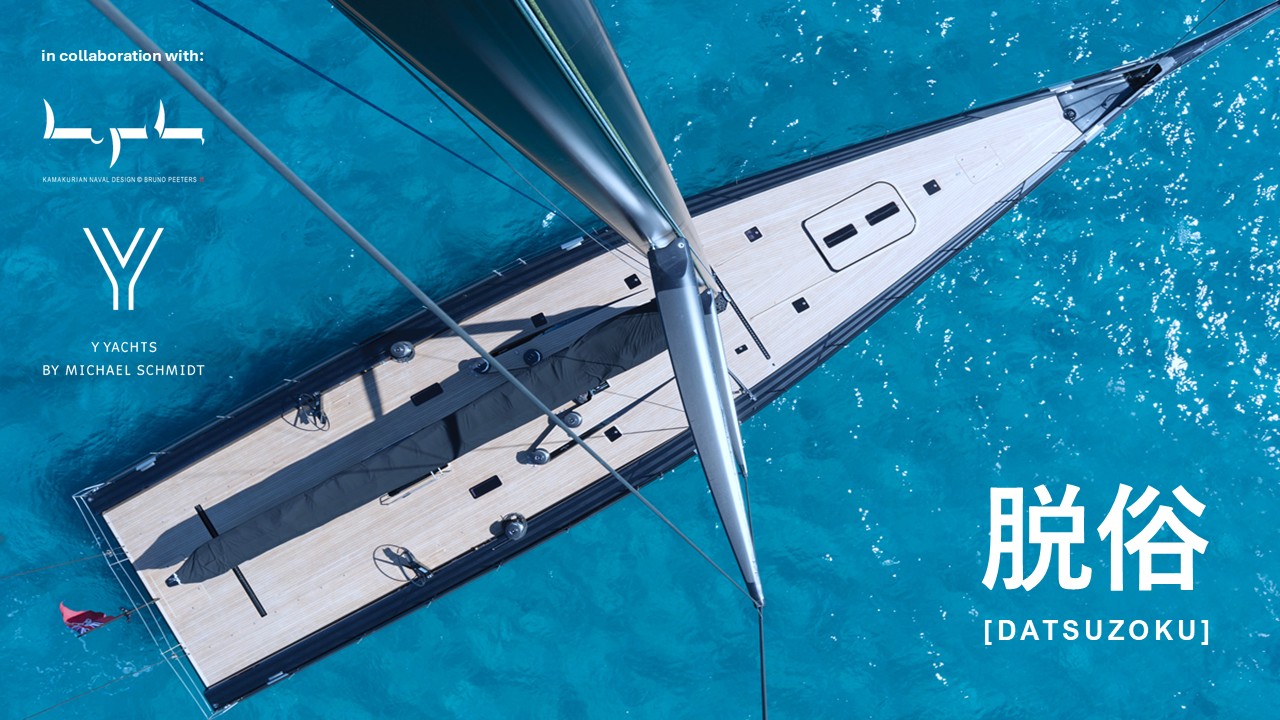
Datsuzoku
Datsuzoku: breaking free from routine Japanese spatial concepts providing guidance to maximise sailing yachts`s ‘open plan’ double hull potentials
MARS3 · GENT · ENGLISH
teacher(s): Bruno Peeters
field of interest: Craft · Fabrication · Media · Alternative Architectural Practice · Research
attitude: Speculative · Critical · Experimental
method of inquiry: Reverse Engineering · Precedent Study · Research by Design
design media: Model-based · Prototyping
learning environment: Individual trajectory · Co-creative
study trip: Optional
Description
Starting from a given 100ft `planing` hull and mast & boom configuration, students develop their own design, choosing between two structural options:
• Single hull & bulkheads
• Dual shell `fuselage`
Either option can be developed along two defining RINA*-compliant design stances enabling both a private or chartering dual use. You will appropriate and interpret a dual shell fuselage design towards a state-of-the-art delivery, that may include 3D models, digital presentations or any other form of representation with a strong focus on applied design and high-level output delivery
In Japanese design, Datsuzoku stands for breaking free from routine and escaping the ordinary & deviating from the commonplace: atypical, open plan sailing yacht design configurations brings with it considerable challenges.
Interpretation and application of traditional Japanese spatial concepts provides critical design guidance, enabling to maximise the flexibility of the ‘open plan’ and an asymmetric ‘function follows hull’ approach.
Hybrid Studio, (on campus & online) in collaboration with Y-Yachts Germany and Kamakurian Design Japan. Digital proficiency recommended. Note provided materials may be subject to separate Non-Disclosure Agreement(s).
(*) Registro Italiano Navale (RINA): compliant with international standards of safety, quality, and environmental performance.
Key questions
[1] Can architectural design advance technological innovation?
[2] You think you`re good at design?
[3] Can you manage spatial optimization, micro-architecture, non-conventional ergonomics and dynamic geometries all at once?
Position statement
Beyond the ‘bling bling’ of oversized and ostentatious motor yachts, Europe is home to a unique sailing yacht ecosystem.
Often featuring advanced technologies, materials and high-end design, at its core the industry remains conservative.
Habitual construction methods, low production numbers and a tendency towards bespoke projects constrain fundamental innovation.
Starting from a novel dual shell ‘fuselage’ concept, students are invited to explore and develop alternative `open plan` configurations, completely overturning conventional sailing yacht design-thinking.
Learning outcomes
(1) The student demonstrates insight into context analysis, concept formation, problem sensitivity and engagement, ethics, and personal imagination. (2) The student is able to formulate an individual research or design strategy. (3) The student demonstrates advanced knowledge and understanding of fundamental structural principles.
Expected deliverables
Model · Publication · Presentation
Study trip
Description: Visit Y-Yachts shipyard in Greifswald (Germany) or Palma office (Spain) – to be decided
Additional cost: +/- 200~250 Eur.
Alternative trajectory: One day visit Metstrade Rotterdam