
Instructor: Wim Oers
Engagement: Craftsmanship
Location: Ghent
Language: English
Semester 1, Fall 2026
CINEMA REX – SUSTAINABLE REGENERATION
Key words: contemporary architecture related to heritage (renovation, conservation & restoration), complex buildings, sustainability (architectural resilience & regeneration).
Context & problem
Since the invention of cinema in the 19th century, motion pictures have transported people across the world into different times and places. As soon as the invention found its footing, people began to come together to see films.
Initially, small rooms that housed inventions like the vitascope became popular; and nickelodeons, where folks could see movies for a nickel, were all the rage. With the advent of Hollywood and the studio system, lavish movie palaces were constructed. In the mid-1930s one could get snacks and other concessions with a movie. By the 1950s drive-ins were popular. The 1960s saw the rise of multiplexes, widescreen, surround sound, CinemaScope, Smell-O-Vision and 3D. Almost at the same time television became commonplace in homes, businesses and institutions. Since the 1980s the availability of various types of archival storage media (such as Betamax and VHS tapes, laser discs, high-capacity hard disk drives, CDs, DVDs, flash drives, blu-ray discs, and cloud digital video recorders) has enabled viewers to watch pre-recorded material, such as movies, at home on their own time schedule.
Eventually, at-home entertainment, spurred by an ever-expanding array of internet streaming services and increasingly sophisticated TV set-ups, removed the need to leave the house. People would, any day, stay back home, stock up on some drinks and snacks, cuddle inside a cosy blanket, and watch movies from the comfort of their home. Meanwhile, cinema ticket prices were rising which further reduced demand.
The Covid-pandemic only exacerbated the problem. When cinemas closed due to lockdown orders, often being some of the last venues allowed to reopen during the temporary lifting of restrictions, movie production houses had already turned towards streaming services to debut their films.
Popular movie streaming platforms include major subscription services like Netflix, Amazon Prime Video and Disney+, alongside free ad-supported options such as Tubi, Plex and Pluto TV.
Even as the movie industry inches closer to a return to normality, streaming services have established themselves as viable alternatives to cinema. The future of cinema remains uncertain, filled with both challenges and opportunities.
Can we make movie theatre visits successful again?
Cinema, however, is not yet on the verge of extinction; but to survive, it shall need to adapt.
Option One: Some believe the key is to make a trip to the cinema once more a unique, customized event for consumers and cinephiles. Movie theatres will have to reinvent themselves by thinking how they can personalise experiences. That involves an entirely new approach far beyond offering better food and more comfortable seats. People will always want to see high-budget (so-called ‘blockbusters’) and/or arthouse films with exceptional special effects and globally beloved stars on a massive screen. Increasingly, cinemas shall have to specialise in showing those types of movies, while studios will prefer a streaming-only release for films that people have no incentive to leave their house for. People will equally want to re-experience the ‘best classic films ever made’ on the large silver screen – preferably in a genuine movie theatre atmosphere.
The elevated experience will be about the submergence into an exclusive architectural world supported by superior techniques. The elegant architecture and interior design of historic movie theatres will be re-appreciated and adapted to future needs.
Option Two: Others believe the key is to add non-cinematic services to the venue such as talks, conferences, lectures, etc.
Subject
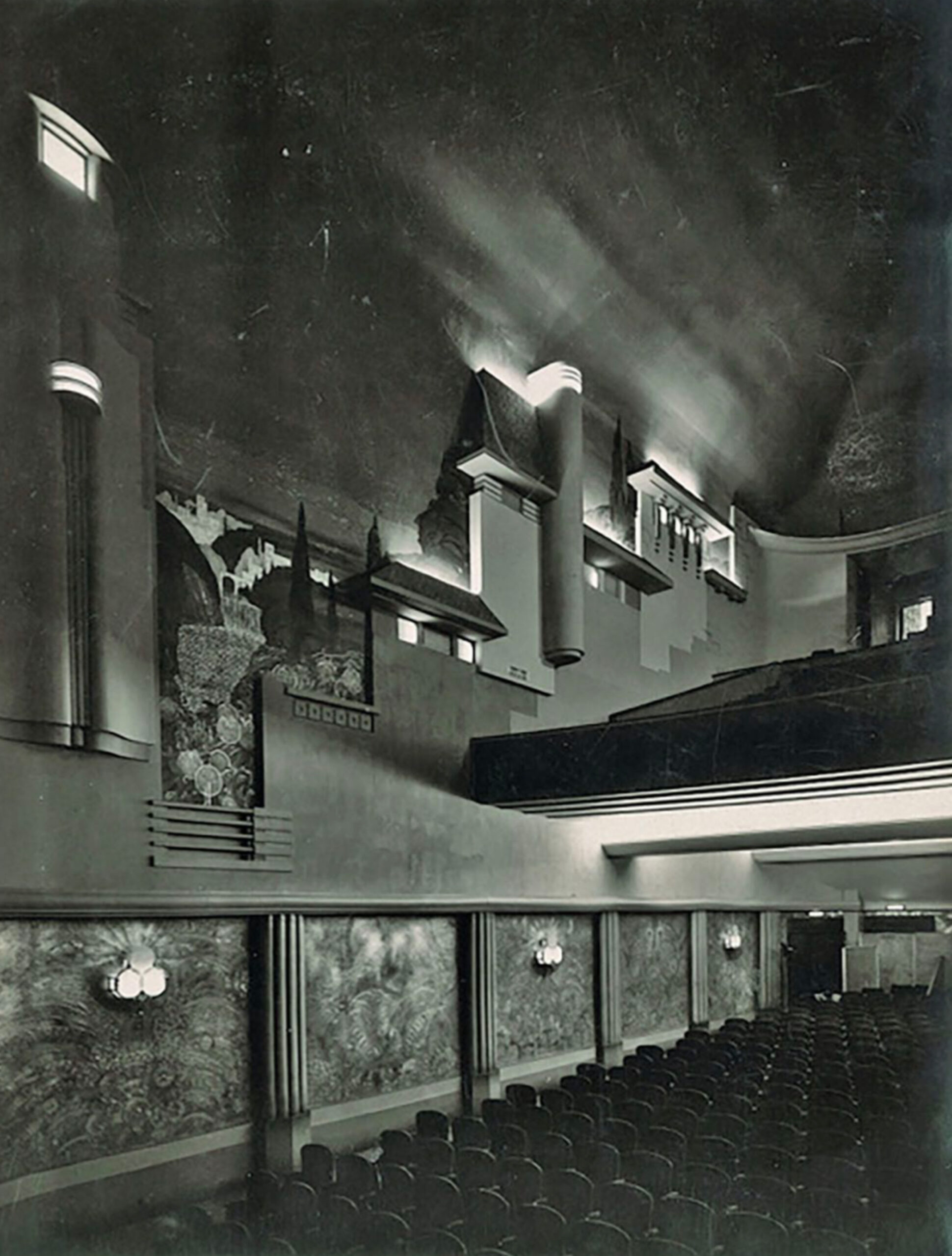
The subject of our study is the legendary Cinema REX (Queen Maria Hendrika Square 35, 9000 Ghent).
The venue, which opened doors in 1933, was designed by architect Geo Henderick (°Ghent, 1879 – +Ghent, 1957) – by then an experienced movie theatre designer. For Cinema REX he developed a high-quality architectural variant on the ‘Atmospheric Movie Theatre’ – a concept developed in the 1920s by the Austrian-American architect John Eberson (°1875 – +1954).
Atmospheric movie theatres offer the illusion of a unique intimate open-air experience.
In such an outdoor atmosphere, the moviegoer enjoys the beauty of idyllic landscapes and skies. The effect of an open-air auditorium is secured through ceiling and side wall treatment enhanced with flood light and special effects.
Eberson believed that the greatest opportunity for service to the industry and the audience that is open to the architect lies in his atmospheric theatre concept by offering a unique experience. It is a service that can be best rendered by courageously and intelligently deviating from the stereotyped run-of-the-mill movie theatres. The architect has to call upon his poetic skills to create something ‘different’ – something artistic that appeals to the senses.
Geo Henderick must have been impressed by Eberson’s Grand Rex (1 Boulevard Poissonnière, Paris, France) when he sojourned in Paris. Inspired by the project, he upgraded Eberson’s movie theatre concept with his own signature style – resulting in an architectural marvel.
With his design, Hendrick made the moviegoer forget the day-to-day worries. Seated on a slope, he made them contemplate a nighty summer sky with sparkling stars and peacefully passing clouds in a Mediterranean courtyard atmosphere designed in his own contemporary formal language.
During the 1950s Henderick’s illusionary interior unfortunately disappeared when architect Frans Merlé ‘modernised’ (read: mutilated) the interior and turned it into something utterly meaningless without any qualities.
Eventually, the limelight died down in 1985 when DVD home movies appeared. Five years later the venue was transformed into a casino.
In 1996 Cinema REX (or what remains of it) was listed as a monument. Being unused for almost 30 years, the venue is gradually falling into decay. About 14 years ago, local action groups campaigned against this situation. A few years ago, our design studio started to develop preliminary projects to show the venue potencies. Our students explored new perspectives.
Recently, Cinema REX and two adjacent properties were acquired by the urban development company SOGENT. It is their general mission to develop Ghent into a city where it is pleasant to live, work, and meet for all. They assist in the implementation of urban policies and real estate management. Their vision is about: Sustainability, Inclusiveness and Beauty (SIB). They are open to innovation and experiment. It is their intention to regenerate the REX. To survive, the venue needs to be updated.
Main Challenge
Our main challenge is to make sure that Cinema REX shall provide in multiple new needs while preserving its unique architectural identity.
The elegant architecture and interior design of this unique historic movie theatre will be re-appreciated and adapted to future needs. To survive, the venue needs to be updated.
Contemporary additions, renovations and restorations are part of the program.
The aim is to turn the REX into a unique multi-purpose venue where not only cinephiles can thrive. The venue will also host talks (such as TED talks), lectures, music performances (such as chamber music and song recitals) as well as educational experiences for children, teens, families, adults and seniors. It would be great if the venue could even take up an educating role by collaborating with museums, university faculties and film schools.
Previously, our students successfully implemented the SIB-vision of SOGENT resulting in a number of distinct interrelated projects: 1) the restoration of the façade, 2) the restoration and renovation of the front building, 3) the reconstruction of Henderick’s original movie theatre hall, and 4) two contemporary additions to be constructed on the newly acquired adjacent properties.
This year, we shall only focus on the design of a totally new contemporary multi-purpose event hall.
Objective
Our objective is to implement SOGENT’s SIB vision by formulating a number of contemporary architectural projects to substitute Geo Hendrick’s initial ‘Atmospheric Movie Theatre’ hall.
Methodology
Design research is central to our agenda. The focus lies on experimental, critical and curiosity-driven research that deals with a wide variety of challenges ranging from the conceptualisation of architecture and its virtual & physical modelling, to the experience of its material manifestation.
The research section entails:
- – the design-oriented exploration of a ‘multi-perspective and layered understanding of the past’. We shall dive into the ‘multiple pasts’ with a fresh contemporary attitude to harvest material for the
- – the design-oriented assimilation of ‘visions’ of respected scholars, public-opinion leaders, decisionmakers, and other stakeholders to be able to work on multi-layered projects designed to address contentious historical issues in a meaningful and impactful manner.
- – the design-oriented use of ‘existing guidelines’ to deal with cultural heritage and
- – the design-oriented exploration of ‘multiple responses’ to problems inherent to future exploitation of the venue.
Output
The output will be a number of design projects (individual or one per group of three to five students) and thematised publications.
Studio Master: Wim Oers, Dipl. Architect (HAISLG), MSc Arch in AAS (The Bartlett, UCLondon), MSc Arch Cons (RLICC, KU Leuven)
Students: This studio welcomes master’s degree students in Architecture and Interior Architecture – both national and International.
Language: English
Literature (chronological – descending)
Deseyn, Guido, ”Gentse filmzalen”, in Stadarcheologie, 7, n° 1, Gent, 1983, p. 28-46. Desseyn, Guido, Geo Henderick 1879-1957 (museum catalogue), Stad Gent, 1984.
Van de Vijver, Lies, Gent Kinemastad: een multimethodisch onderzoek naar de ontwikkeling van filmexploitatie, filmprogrammering en filmbeleving in de Stad Gent en randgemeenten (1896-2010) als case binnen New Cinema History onderzoek, PhD thesis, University Ghent, 2011.
Gjestland, Rolv, How to design a Cinema auditorium – Practical guidelines for architects, cinema owners and others involved in planning and building cinemas, UNIC (International Union of Cinemas), 2020.
Archives
Archief Henderick, Museum voor Sierkunst, Jan Breydelstraat 7, 9000 Gent. Archief Gent, De Zwarte Doos, Dulle-Grietlaan 12, 9050 Gent.