
Title: Architecture and Territory – FLOODSCAPES – cases Vesdre (BE) – Valencia (ES)
Tutors: Bart Van Gassen and Ignacio Galan
Campus: Ghent
Language: EN
Engagement: Urban Cultures
Semester 1
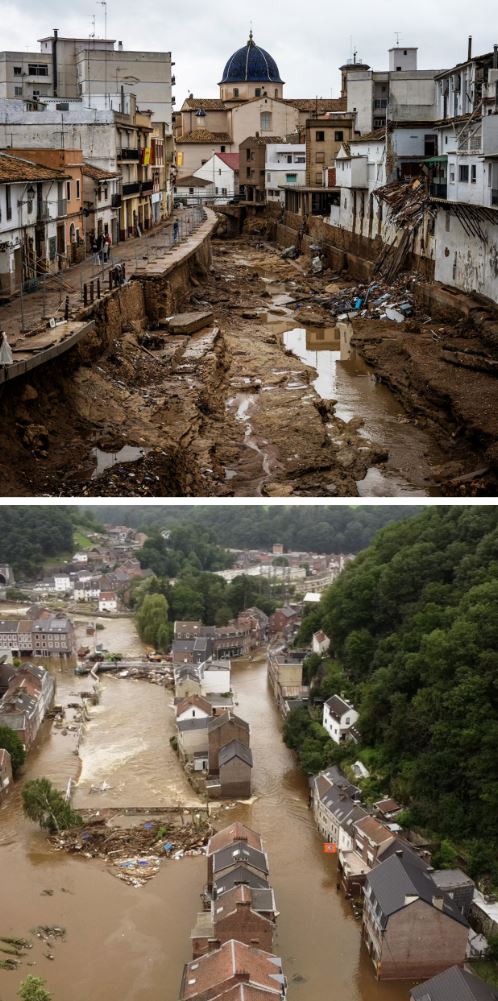
Cover image:
(Top) The destructive effects at the Rambla del Poyo after the flooding in Chiva, Valencia. (Claudio Álvarez, 2024)
(Bottom) The Vesdre Valley at Pepinster is flooded during the waterbomb. (Vedia, 2021)
Architecture and Territory: FLOODSCAPES. Vesdre (BE) – Valencia (ES)
ABSTRACT
The STUDIO ARCHITECTURE AND TERRITORY operates on the INTERFACE BETWEEN ARCHITECTURE, URBANISM AND LANDSCAPE. This year’s studio will focus on FLOODSCAPES in the VESDRE REGION (BE) and in VALENCIA (ES), two sites that recently were the scene of large floods with dramatic human and material losses. In the studio we will deeply engage with these territories and sites. Developing an understanding of its specific conditions and potential through the TRANSFORMATION OF THE GROUND AND PUNCTUAL SPATIAL INTERVENTIONS.
TOPIC – Floodscapes: learning to live with water
The increasing IMPACT OF CLIMATE CHANGE – more frequent, more intense, and more unpredictable floods and droughts – underscore the urgent need to rethink the capacity of cities and regions to adapt to these challenges. Conventional urban planning and design, centred on purely infrastructural responses, have proven insufficient against these challenges.
This design studio approaches SITES OF CRISES. Facing reconstruction processes as an opportunity to rethink the built environment and the broader territory, addressing interconnected issues such as environmental loss, productivity, collective spaces, and social facilities. As the urbanisation of large flood-prone neighbourhoods cannot be easily reversed, it explores how climate extreme events can MOTIVATE A PROFOUND REFLECTION AND CATALYSE MORE SUBTLE STRATEGIES to increase adaptation capacity that take into consideration, for instance, water management (related to floods and droughts) as well as the efficient use of scarce resources.
COLLECTIVE SPACES EMERGE AS CRITICAL ELEMENTS FOR SOCIO-ECOLOGICAL RESILIENCE in flood-prone areas. They articulate the social and ecological dimensions of the territory, offering places of encounter, care and community-building capacities.
CASE – Vesdre (BE) + Valencia (ES)
We will work on two cases: the VALLEY OF THE VESDRE in Belgium and the area of HORTA SUD in Valencia, Spain.
On the 14th of July of 2021 a “waterbomb” flooded and destroyed a large territory in the vicinity of Liège. 39 people died and the damage was estimated more than 2,5 billion euro. The VALLEY OF THE VESDRE is in the heart of this natural disaster. Since 2021 the regional government developed a “strategic plan” for the Vesdre. And first steps are made to rebuild the region.
More recently, on the 29th of October in 2024 a massive flood hit the peri-urban area of Valencia, particularly Horta Sud. Several municipalities located along the RAMBLA DEL POYO (a ravine or dry river that ends in the natural marshlands of the Albufera lagoon rather than the sea) were struck. This natural disaster resulted in 237 human casualties, becoming one of the deadliest natural disasters in European history.
TWO DIFFERENT CASES WITH VERY DIFFERENT SPATIAL AND CLIMATIC CONDITIONS. The valley of the Vesdre: a set of small villages in the forested region of the “Land van Herve” and the “Hoge Venen” in a north European temperate climate. The neighbourhoods of Horta Sud with the Rambla del Poyo in Valencia: a peri-urban context in a mediterranean climate.
APPROACH – Architecture and territory: topography and (im)permeability
The STUDIO ARCHITECTURE AND TERRITORY operates on the INTERFACE BETWEEN ARCHITECTURE, URBANISM AND LANDSCAPE. The challenges and urgencies are approached from the perspective of the OPEN SPACES in the city. Spatial research and design JUMP SCALES: taking into account simultaneously the TERRITORIAL SCALE and the ARCHITECTURAL DETAIL.
Each ARCHITECTURAL INTERVENTION will mobilize spatial, social and ecological forces and address existing and new collectives – human and non-human – in the urbanized territory. This to transform the physical condition of the city, to boost its cultural and social imagination and to strengthen our link with the given world (the soil, water, animals, plants…). Through this making a contribution to a more democratic and a more TERRESTRIAL TERRITORY AND WAY OF LIFE (see Bruno Latour).
Interventions will focus on the PROJECT OF THE GROUND (see Bernardo Secchi). In a very literal way this means making topographical and material changes to the surface of the earth: adding, moving or removing, shaping … earth. And combining this with constructing, demolishing, reorganising … material surfaces or architectural elements. This approach is strongly linked to PROCESS ART AND LAND ART as it emerged in the late sixties and early seventies of the 20th century. The work and texts of protagonists like Nancy Holt, Eva Hesse, Robert Smithson, Robert Morris, Walter De Maria, Richard Long … will take a guiding role in the design studio.
INTERNATIONAL COLLABORATION – Ghent/Valencia/Stuttgart/Liège
In our studio we collaborate with other EUROPEAN UNIVERSITIES who have been investigating parallelly these topics in our study areas during the past years: the Advanced Master in Urbanism and Landscape of the Universidad Politècnica de Valencia, the Master in Architecture of University of Stuttgart, and the Faculty of Architecture at University of Liège. This INTERNATIONAL AND MULTIDISCIPLINARY EXCHANGE brings together Master’s students and teachers of architecture, urbanism and landscape design. Lectures, data, feedback sessions and final presentations are shared, contributing to provide new perspectives to our studios, to learn from each other, and to expand our knowledge.
- Bio teachers (pdf)
- Methodology (pdf)