
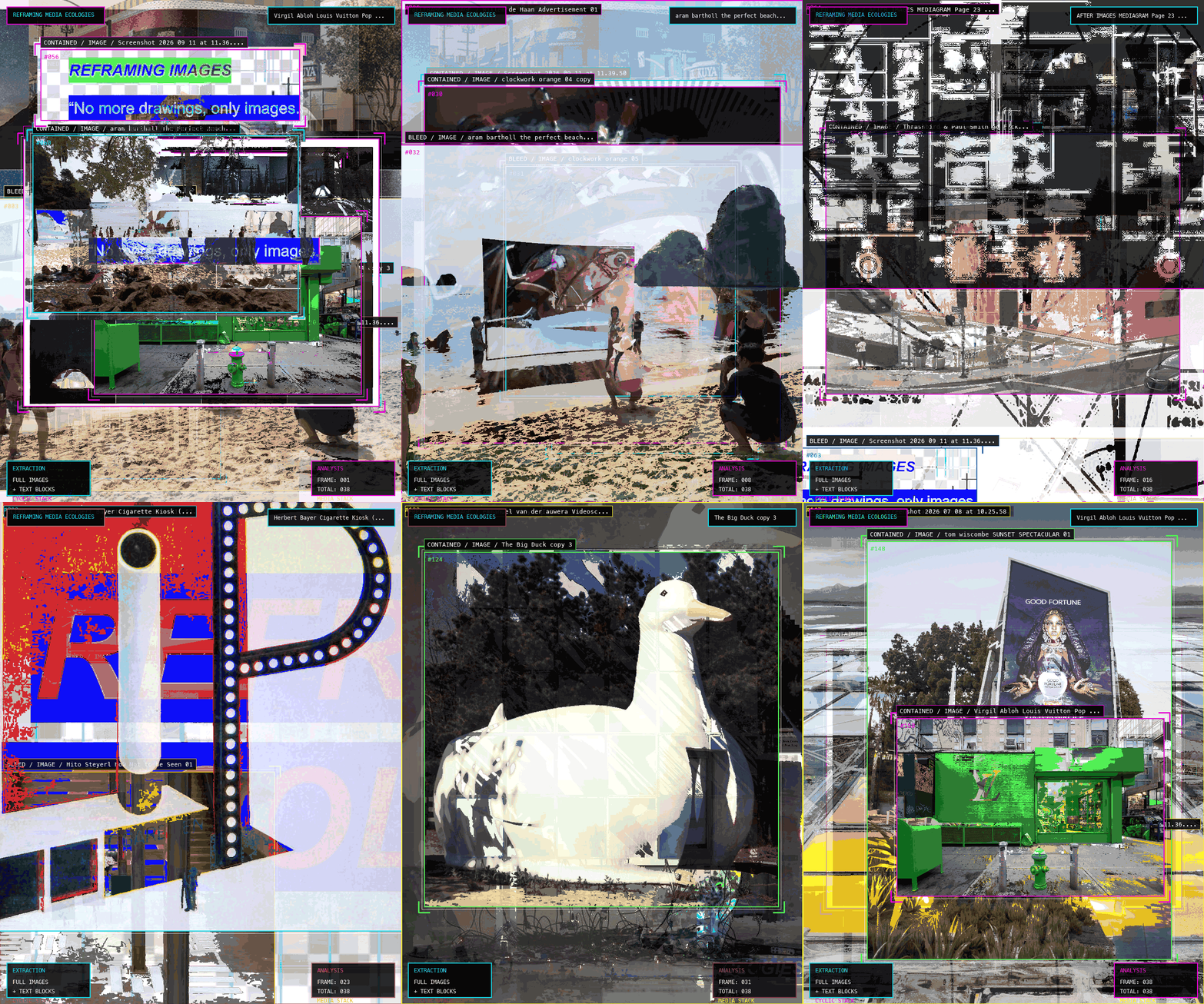
After Images: Reframing Media Ecologies
Interrogating what lies after the image through spatial interventions that critically engage with, expose, and reframe contemporary media ecologies.
MARS1 · GENT · ENGLISH
teacher(s): Michiel Helbig · Corneel Cannaerts
field of interest: Ecology · Media · Alternative Architectural Practice · Transformation · Research
attitude: Speculative · Experimental · Critical
method of inquiry: Research by Design · Translation · Precedent Study
design media: Narrative · Diagramming, data visualisation, time-based media
learning environment: Collective learning · Iterative · Dialectic
study trip: Optional
Description
Fieldstation Studio explores how architecture and spatial design can critically engage with the proliferation of networked digital technologies and media within our environments. We are particularly interested in how images, data, algorithms, platforms, and infrastructures shape how environments are perceived, represented, organized, and produced and, reciprocally, how these environments condition the media operating within them. Rather than understanding media simply as content or representation, the studio approaches media ecologies as material and operational entanglements of spatial, technological, economic, political, social, and ecological conditions.
After Images: Reframing Media Ecologies interrogates how images and media materialize and operate across environments, deploying reframing as both an analytical lens and a propositional design strategy. Starting from a curated collection, students select one image as an entry point into particular questions, conditions, and entanglements. Moving beyond its visible frame, they uncover the systems and relations through which it is produced, processed, circulated, and made operational. Through research and computational workflows such as web scraping, image processing, and mapping, they investigate entanglements of image, data, and matter.
This research is brought together in a mediagram: a visual mapping that traces three interconnected dimensions — mediality, mediation, and media ecology. It asks how the image is technically and materially produced, how it frames and constructs meaning, and what wider networks, infrastructures, actors, and environments it participates in. Images are thus approached not only as things to be seen, but as operational entities embedded in larger technological and material systems. Students identify a conflict, paradox, urgency, or emerging condition, formulate a critical position, and translate this diagnosis into a speculative spatial proposition.
The studio’s ambition is to turn critical diagnosis into tangible design action. Rather than simply representing or carrying media, the project becomes an active agent within its media ecology: it may expose hidden operations, make relations perceptible, question or appropriate existing systems, redirect their effects, or establish alternative modes of mediation. It can engage with visible and invisible forms of media — from images and interfaces to data, algorithms, signals, sensors, platforms, and machine vision — across different spatial and temporal scales.
The final output develops the proposition through a spatial construct and a series of animated fragments. Fieldstation Studio seeks to extend the architectural toolbox through audiovisual, computational, time-based, and other modes of representation. The spatial construct articulates spatial and material logic, while the animations explore operations, perspectives, scales, data layers, hidden relations, transformations, and temporal conditions that cannot be contained within a single static representation. Through their interplay, the project moves between material and immaterial, visible and invisible, static and dynamic dimensions of contemporary media ecologies, exploring how architecture can operate within and reframe them.
Key questions
(1) What lies beyond and after the image? How can we uncover the hidden technological, economic, political, and material relations embedded in contemporary media, making seemingly immaterial systems perceptible? (2) How do media ecologies shape our environments? How do operational images, data, and algorithms interact with physical space, constructing and conditioning the environments in which they circulate? (3) Across what spatial and temporal scales does the mediated city operate? How do media ecologies connect pixels, sensors, and interfaces to global supply chains, infrastructures, landscapes, and planetary systems? (4) How is architecture implicated in digital media cultures? Beyond visual representation, how does architecture participate in platforms, computation, data flows, and physical media infrastructures? (5) How can spatial interventions reframe and contest these realities? How can spatial constructs intervene in the production, processing, and circulation of images to articulate alternative spatial and political realities?
Position statement
Media and images are not neutral representations but operational and material entities that actively frame, format, and produce our environments. After Images deliberately carries multiple meanings: we are increasingly after images, producing, consuming, and pursuing them; we need to look after and beyond their visible surfaces to uncover the infrastructures, data, algorithms, economies, politics, and ecologies through which they operate; and we want to question what might come after an increasingly accelerated and saturated image culture. Like an afterimage, what remains is never simply the original image, but its traces, transformations, and effects. The studio adopts reframing as both a critical and propositional strategy, tracing these entanglements beyond the visible frame and using computational and spatial design to expose, question, and intervene in the realities they produce.
Learning outcomes
(1) Innovative Architectural Design: The studio expands the architectural toolbox by combining spatial constructs with computational workflows (web scraping, image processing, data visualization) and time-based media (video, animation). Moving beyond static form-making, students develop spatial interventions that expose, interrupt, and reframe contemporary media ecologies and infrastructures. (2)Visual and Graphic Skills in Design: Visual representation becomes an analytical and generative tool rather than a passive means of rendering. Through mediagrams and animated fragments, students map complex operations and systemic relationships, making invisible dimensions such as data flows, algorithms, and ecological entanglements spatially perceptible. (3) Conceptual and Programmatic Rationale: Design briefs emerge from research-led investigations into curated media artifacts rather than being predetermined. Students identify political, technological, or ecological conflicts within visual culture and translate this critical diagnosis into coherent, engaged, and context-responsive spatial propositions.
Expected deliverables
Architectural drawings · Written reflection · Process documentation · Installation · Film/Video · Digital media · Presentation
Study trip
to be confirmed